01
Isabel Pons : percurso de uma exímia gravadora
Catalogue·2025
Catalogue of the exhibition held at the Câmara dos Deputados, from October 23 to November 27, 2025, in the Galeria Décimo, Anexo IV. Curator: Oto Reifschneider.
Publications
This section brings together the books, scholarly articles, curatorial texts, interviews, and catalogues I have produced over the years. This body of work ranges across bibliophilia and book history, concrete poetry, Brazilian printmaking, illustration, and studies devoted to artists and collections, as well as the recovery of aspects of Brazil’s graphic and cultural history and the documentation of previously little-known archives.
Catalogue of the exhibition held at the Câmara dos Deputados, from October 23 to November 27, 2025, in the Galeria Décimo, Anexo IV. Curator: Oto Reifschneider.
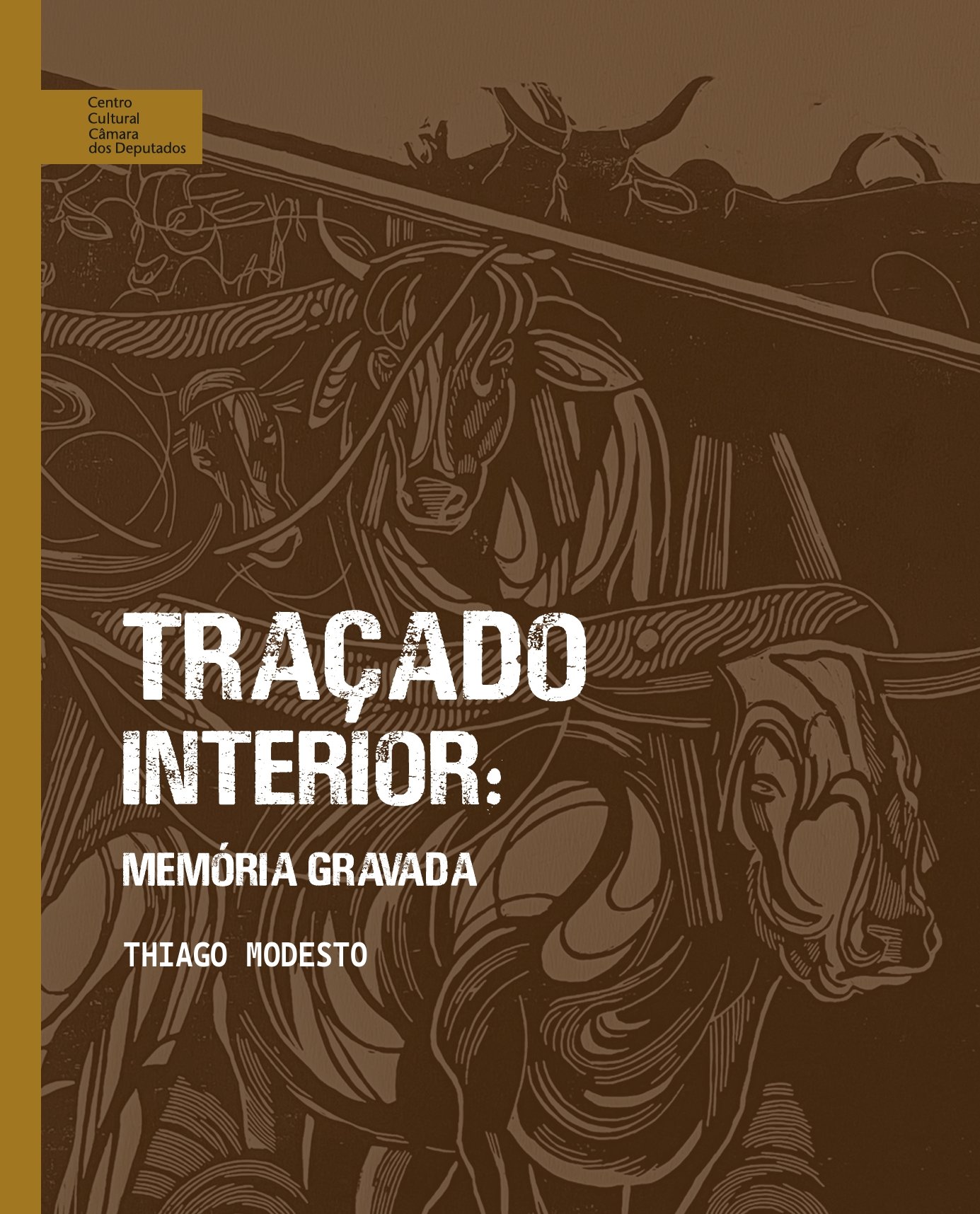
Catalogue of the exhibition held at the Câmara dos Deputados, Galeria Décimo, Anexo IV, from September 27 to October 24, 2024. The exhibition brings together 38 woodcuts by Thiago Modesto, produced between 2020 and 2024, from the series Pindoranes, Sertão Carioca, and No Longe.

Luis Matuto, a young artist from Minas Gerais, is one of the most distinguished printmakers of his generation. In Belo Horizonte, he is also a reference in graphic design—activities that complement and overlap with one another. In the inevitable tension between artistic freedom and concerns with the effectiveness and clarity of the message to be delivered, a singular body of work emerges.

Amid sculptures, drawings, and prints, Fernando Lopes keeps his work. They fill drawers, folders, cabinets—they are everywhere and, at the same time, they are not. Let me explain: the drawings were accumulated, gathered even with a certain order, with a certain care, but their fate is none other than an archive of the visual memory of their maker. They are the unmistakable proof that Fernando worked, and worked a great deal, over the past decades.

In his notebooks, Sergio Rizo brings together drawing as a continuous exercise in observation and graphic thinking. The exhibition traces the intimate path of an artist who makes drawing a way of inhabiting the world, between the record of the everyday and the invention of the line.

In the wake of «Brazil Qatar 2014», the purpose of this exhibition is to show Doha a glimpse of Brazilian art through the richness of its printmaking tradition. This panorama will showcase Brazilian printmaking, from its founding fathers to contemporary artists, including representatives from several relevant movements and regions. These prints are part of the curators private collection of over two thousand original prints, one of the richest of its kind in his hometown Brasilia, the capital of the country.

Few today will know who Tomás Santa Rosa was. Born in Paraíba in 1909, he made his way to Rio de Janeiro in the 1930s. It was in the federal capital that the arts and letters of the time were made. Self-taught, he became a deep connoisseur of music, theater, and the arts—he had a great regard for technique. He became a master of drawing and composition, also devoting himself to teaching. He was one of the most important figures in the process of cultural modernization of the country, leaving his mark from the graphic arts to the theater.

In memory of my friend Athos, who left us on December 19, I write these lines. And why do I recount all these stories, details of what united and separated us? Because these movements are the very stuff of life.

The three artists presented here have very distinct trajectories and bodies of work. The thread that unites them is, beyond figuration, the technique employed: all the works on display are prints. Moreover, they all belong to the holdings of the MAB, the Museu de Arte de Brasília, created in 1985 with the collection formed by the Secretaria da Cultura in the preceding decades. Closed since 2007, awaiting renovations, the Museu Nacional da República currently holds the collection in its keeping.

The essay recounts, privileging the voice of Augusto de Campos, the editorial production processes of Brazilian concrete poetry, from the Noigandres group and its later developments. It reconstructs the difficulties the concretists faced in circulating their works and presents little-known data about the materiality of the texts. It reveals the involvement of visual artists, such as Julio Plaza, of patrons such as Erthos Albino de Souza, of artisan publishers, such as those linked to the publishers Annablume and Noa Noa, as well as other publishing imprints that contributed to the consolidation of Brazilian poetic vanguardism in the book market.

Lying in bed, between dreams, memories, and desires, Darel draws. A lifetime refining the senses, training the hand, the firm line on paper. There are paintings, prints, collages, and drawings, above all drawings. He never made sculpture, nor wished to. Of woodcuts—the most sculptural of the print forms—he made only one, incomplete and precious. It is the magic of the plane that attracts him. When he is not producing art, he consumes it: he loves music, cinema, dance, literature.

Rubem Campos Grilo, from Pouso Alegre, Minas Gerais, was born in 1946. Since the early 1970s, he has developed a broad and intense body of work in woodcut printmaking. He is today one of the leading artists in production in the country and one of the highlights of Brazilian printmaking. This in-depth interview was given to Oto Reifschneider on the morning of January 20, 2012, at his home in Rio de Janeiro.

The history of the neglect of books in Brazil has yet to be told. Its episodes, however, are as old as the presence of the book in the country, which takes shape in the late Colonial period. This article compiles some of these episodes, drawn both from the specialized literature, grounded in historical accounts, and from firsthand testimony. It matters to show that the problem is not only historical but current, and must be remedied as soon as possible, so that we do not suffer irreparable losses to the construction of Brazilian culture.

One of the best-known and most respected Brazilian printmakers, Darel Valença Lins worked as an illustrator of periodicals and books in a striking way. This article attempts to survey the bibliography of Darel as illustrator, presenting part of his path and his way of thinking. To this end, a meticulous research was carried out in libraries, bookstores, and private collections, with the books and albums of prints being catalogued.

Brazilian visual poetry, of which the exhibition OBRANOME is a precious sample, has its origins in the 1950s, with the emergence of concrete poetry, maintaining its character of a collective vanguard until the late 1960s. At the outset, it involved the Campos brothers and Décio Pignatari, who formed the Noigandres group, as well as Reynaldo Jardim, Wlademir Dias-Pino, and Ferreira Gullar, among others. Dias-Pino, whose experiments dated back to earlier times, in Cuiabá, persisted for some years before moving on to what would become the poema-processo—a movement of wide reach among poets and artists, especially in its golden phase (1967–1972). Concrete poetry and the poema-processo penetrated the national psyche so deeply that their roots would nourish the artistic-literary milieu for the following decades, from the south to the north of the country.

The material aspects of the production of books and pamphlets of a given literary movement are, at times, as curious as the elaboration of the writing itself, for they are an intrinsic part of the genesis and dissemination of the movement. It was the search for this knowledge in relation to concrete poetry that led me, in mid-2009, to converse with Augusto de Campos and, subsequently, to seek out other agents of this process, co-responsible for that production. These aspects of cultural creation, which usually go unnoticed, are lost through the little importance given to them: this information is seldom recorded, let alone disseminated. In the case of concrete poetry, two names already stand out: in the making of the works, the striking figure was Julio Plaza (1938–2003); in financial support, the unsparing patronage of Erthos Albino de Souza (1932–2000).

I came to know Salvador Monteiro through the books of Alumbramento, his publishing house. I had bought, for my collection, Amor Canto Primeiro 2 and Elegias, the first two volumes he published, but what truly enchanted me was the special edition of Alumbramento, with original prints by Darel, Grassmann, Bianco, and Aldemir Martins, the illustrators of the book. The care with which the book was composed and printed, the folds of the box, the record with poems recited by Bandeira, and the prints made me want to know more. The only reference I had found about the publisher, save for a few journalistic features, were a few paragraphs and the listing of works made by Professor Knychala in her O Livro de Arte Brasileiro. I consulted some of these works at the BCE, the library of the University of Brasília. The fact that I could find almost no reference to Salvador, and that I had only been able to access a few of his books, intrigued me even more. I obtained his contact, and after two years of missed attempts to schedule an interview, I succeeded. I went to meet him and was able to learn more about his work, over a pleasant conversation.

Full of life, full of ideas, Reynaldo Jardim has passed away. My acquaintance with the poet and journalist came at the end of 2007, through the purchase of his books at a secondhand bookstore in Brasília that had acquired the library of the artist Rubem Valentim—one of the many sad stories of neglect of our culture.

One of the events that most marked me, over years of study at the University of Brasília, was a lecture by Décio Pignatari, on December 12, 2003, a Friday. What was striking was not the eloquence, the beauty, or any other intrinsic quality of the speaker, but the audience. There was no one. I still knew little about the poet, the translator, the essayist, and the professor. I had read only some of his concrete poems from the 1960s. I was, however, aware of his relevance to communication and his primary role in the development of concrete poetry.

This article problematizes the relationship between phenomenology, specifically the methodological strand of Alfred Schutz’s sociological philosophy, and the foundations of the flexible systems methodology.

In preparing this dissertation, bibliophilia in Brazil was investigated in its historical, sociological, and communicational aspects. Following the initial methodological discussions, a survey was made of the expansion of “book studies.” The situation of the book in the country was then studied, focusing on the historical neglect of national public collections, as well as the examination of specific aspects such as the history of the ex libris and of bookbinding. From a broad bibliographic survey, an attempt was made to trace a brief history of bibliophilia in Brazil, identifying not only the collectors but also the fate of their collections, highlighting some of the most important figures. Drawing on the most recent literature and previously established contacts, contemporary bibliophiles were mapped and, when possible, contacted and interviewed. The second part of the dissertation, i.e., the analysis of various aspects that make up the oeconomia of bibliophilia, was carried out primarily from conversations with those bibliophiles and booksellers and from observations made in situ in the cities visited. An attempt was made to demonstrate not only the practice of the bibliophile in its many aspects, but also its social role and its implications within and beyond the network formed by bibliophilia. To this end, symbolic, aesthetic, and economic aspects were discussed, from the fascination with the rare work to the importance of private libraries.

This article proposes the book as a museological object, i.e., that the material aspects of the book be considered in order to understand its pivotal role in society. To this end, three aspects of this book-as-museological-object are developed: the social, the material, and the aesthetic.

An important man of letters from Pernambuco, a promoter of the history of the press and of his state, Alfredo de Carvalho, due to his premature death, did not receive the recognition he deserves. He was part of a select group—alongside the Barão de Studart and Oliveira Lima—that united the writing of history with the formation of precious libraries. He was, in fact, an inveterate bibliophile, concerned with aesthetic and tactile aspects, as well as with the material preservation of the works he gathered. Unfortunately, both his library and his unpublished writings—of which there were many—were dispersed. From the letters sent to Oliveira Lima, his bibliographic output, the sale catalogue of his collection—the Bibliotheca brasiliense selecta—as well as some copies that belonged to his library, this article proposes to present one of the least explored facets of Alfredo de Carvalho: that of the bibliophile.

Starting from an introductory discussion on the identification of rare works, the article then addresses their preservation and access, concluding with a brief reflection on the possible benefits of valuing this precious heritage, both for the community and for libraries.

The enterprises of the creative sector’s production chains inject about R$ 152.9 billion into the Brazilian economy, 11.4% of the total moved in 2010. The data come from the report of the United Nations Conference on Trade and Development (UNCTAD) and serve as a reference when the subject is the Creative Economy. However, little is still known about the real indicators of these sectors. Historically, the mapping of quantitative and qualitative data and the establishment of indicators on the cultural production chains and their impact are scarce. Although growing, initiatives aimed at this kind of survey remain few, yet they are essential to identify the potentials and bottlenecks of this network of professionals in the production of their goods and services.

At home, Milan surrounds himself with art. There are paintings, sculptures, prints, and drawings—all his own—filling the available space. At one time, he also had on the walls works by fellow printmakers, such as José Assumpção Souza, whom he had met back in Rio de Janeiro. If today these works are in the drawer, the testimony remains in the stain of the sun on the paper. A sun that passes silently between the blocks of a panel in the living room, whose beauty is reserved for those inside. The coffee table, between the sofas, is made of copper matrices—one almost wants to print it. The silence is broken only by the song of the birds that visit the garden.
Scholarly articles
Books and chapters
Catalogues
Curatorial texts
Essays
Interviews
Doctoral dissertation and academic works